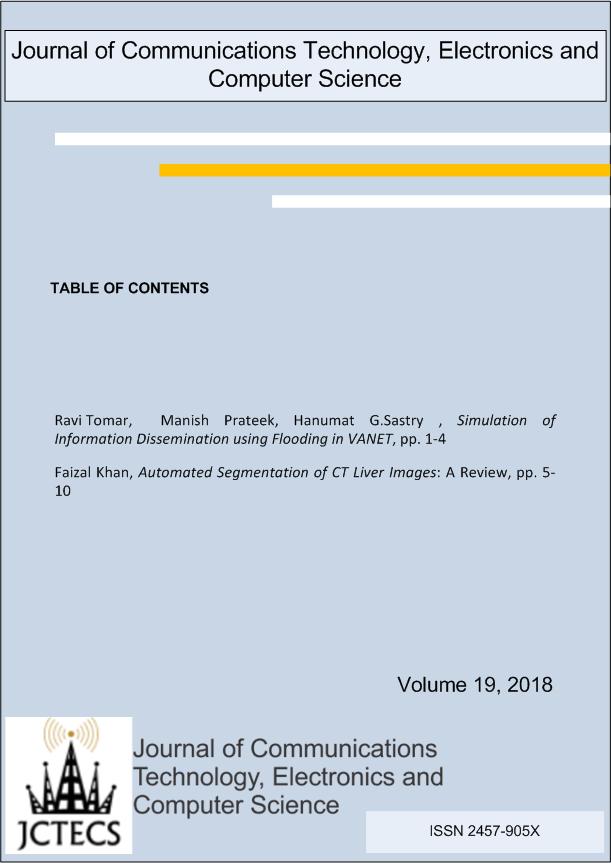
Automated Segmentation of CT Liver Images: A Review
DOI:
https://doi.org/10.22385/jctecs.v19i0.266Keywords:
CT liver Segmentation, Liver decease, Artificial Neural Networks, Machine Learning, Clustering based Methods.Abstract
Segmentation of liver region from CT abdominal images has attained a massive importance in the field of medical imaging, Segmentation is the fundamental process for the identification of tumor present in the liver and also used to identify the various other diseases present in it. volume measurement of the Liver and its rendering also one of its major applications. Various automated methods for segmenting the liver images are reviewed in this paper and proposed a literature review. In general, segmentation techniques for Liver images can be semi-automatic and fully automatized in nature. In this paper, various approaches, applications and its related problems has been explained for the fully automatized techniques of liver image segmentation.Downloads
References
M. Mharib, A. R. Ramli, S. Mashohor, R. B. Mahmood, “Survey on Liver CT image Segmentation Methods” in Artif Intell Rev 37: pp. 83-95 Springer 2012.
D Tsai, N Tanahashi “Neural-network-based boundary detection of liver structure in CT images for 3D visualization” In: Proceedings of IEEE international conference on neural networks, IEEE Catalog Number: 04CH37541, vol. 6 (1); 1994. 0-7803-8359-1pp. 3484-89.
J. E. Koss, F. D. Newman, T. K. Johnson, DL Kirch(1999) “Abdominal organ segmentation using texture transforms and a hopfield neural network”. IEEE Trans Med Imaging 18(7): pp. 640–648.
S. A. Hussain, E. Shigeru, “Use of neural network for feature Based Recognition Of Liver Region On CT Images”, 0-7803-6278-0/00$10.0(C)2000 IEEE
M. M EL-Gendy, F. E. Bou-Chadi, “An automated system for classiyfing computed tomographic images” 26th National Radio Science Conference (NSRC2009).
A. Rafiee, H. Masoumi, A. Roosta, “Using neural network for liver detection in abdominal MRI images” in IEEE International conference on signal and image processing applications.
H. Masoumi, A. Behrad, M. Ali Pourmina, A. Roosta, “Automatic Liver Segmentation in MR images using an iterative watershed algorithm and artificial neural network”, in Biomedical signal processing and control, pp. 429- 437 Elsevier 2012.
S. Luo, Q Hu, X. He, J. Li, J. S. Jin, M. Park, “Automatic Liver Parenchyma Segmentation from Abdominal CT Images Using Support Vector Machines”, IEEE 2009.
S. Mallat, “Multifrequency Channel Decomposition of Images and Wavelet Models”, IEEE Trans. Acoustic, Speech and Signal Processing, 37, 12, 1989 pp. 2091-2110.
S. Luo, J. S. Jin, S. K. Chalup, G. Qian, “A Liver Segmentation Algorithm Based on Wavelets and Machine Learning”, International Conference on Computational Intelligence and Natural Computing, 978-0-7695-3645- 3/09 $25.00 © 2009 IEEE
J. Lu, D. Wang, Lin Shi, Pheng Ann Heng, “Automatic Liver Segmentation in CT images based on Support Vector Machine” in proceedings of the IEEE-EMBS International Conference on Biomedical and Health Informatics, pp. 333-336, 2-7 Jan 2012.
M. A. Selver, A. Kocaoglu, G.K. Demir, H. Dogan, O. Dicle, C. Guzelis, “Patient Oriented and Robust Automatic Liver Segmentation for pre-evaluation of Liver Transplantation” ELSEVIER, computers in Biology and Medicine 38 (2008) 765-784.
Y. W. Chen, K. Tsubokawa, A. H. Foruzan, “Liver Segmentation from Low-Contrast Open MR Scans Using K- means Clustering and Graph-Cuts” ISNN 2010, Part II, LNCS 6064, pp.162-169 © Springer-Verlag Berlin Heidelberg 2010
Z. Yuan, Y. Wang, J. Yang, Y. Liu, “A novel automatic liver segmentation technique for MR Images”, 2010 3rd International Congress on Image and Signal Processing (CISP2010).
R. Kaur, L. Kaur and S. Gupta, "Enhanced K Mean Clustering Algorithm for Liver Image Segmentation to Extract Cyst Region", IJCA Special Issue on Novel Aspects of Digital Imaging Applications (DIA) (I ): pp. 59-66, 2011.
S.S. Kumar ,R.S. Moni, J. Rajeesh, " Automatic Segmentation of Liver and tumor for CAD of Liver", Journal Of Advances In Information Technology, Vol. 2, No. I, February 2011.
C. Lee, P. C. Chung, H. Tsa (2003), “Identifying multiple abdominal organs from CT image series using a multimodule contextual neural network and spatial fuzzy rules”, IEEE transaction on Information Technology in Biomedicine, Vol. 7, No. 3: 208-217
S. Wang, D. Fu, M. Xu, D. Hu, Advanced fuzzy cellular neural network: Application to CT liver images, Artificial Intelligence in Medicine, Vol. 39, No. 1, 65-77, 2007.
Y. Zhao, Yunlong Zan, Xiaofang Wang, Guiyuan Li, “Fuzzy C-means Clustering- based Multilayer Perceptron Neural Network for Liver CT Images Automatic Segmentation”, 978-1-4244-5182-1/10/$26.00, 2010 IEEE.
Chi, Y. Zhao, M. Li, “Automatic Liver MR Image Segmentation with Self Organizing Map and Hierarchical Agglomerative Clustering Method” in 3rd International Congress on Image and signal processing, 978-1-4244- 6516-3/10/$26, 2010 IEEE.
T. Heimann “Comparison and evaluation of methods for liver segmentation from CT datasets” IEEE Trans Med Imaging 28(8) August 2009: 1251–1265
P. Campadelli, E. Casiraghi, A. Esposito, “Liver Segmentation from Computed Tomography Scans: A Survey and a New Algorithm”, Artificial Intelligence In Medicine (2009) 45, 185-196, ELSEVIER.
Downloads
Published
Issue
Section
License
The journal is currently an open access journal.
The articles receive both rigorous peer-review and expedited online publication.
The journal encourages young researchers to submit their unpublished papers.
The authors retain their article’s copyright.
The authors retain publishing rights without restrictions.
Thus, authors may use their own articles for the following non-commercial purposes without asking our permission (and subject only to acknowledging first publication in Journal of Communications Technology, Electronics and Computer Science and giving a full reference or web link, as appropriate).
Authors cannot submit a manuscript for publication to other journals simultaneously. It is a waste of valuable resources because editors and referees spent a great deal of time processing submitted manuscripts. It is also unethical to republish similar research articles (text/figures/tables) again because journals have limited page space and it most likely violates copyrights which have already been transferred to the first journal. Therefore, all journals require a signed author's copyright transfer agreement stating the originality of the research work submitted through a manuscript. As stated above that authors should submit original, new and unpublished research work to the journal. The ethical issues such as plagiarism, fraudulent and duplicate publication, violation of copyrights, authorship and conflict of interest are serious issues concerning ethical integrity when submitting a manuscript to a journal for publication.
The contents of papers are the sole responsibility of the authors, and publication shall not imply the concurrence of the Editors or Publisher.