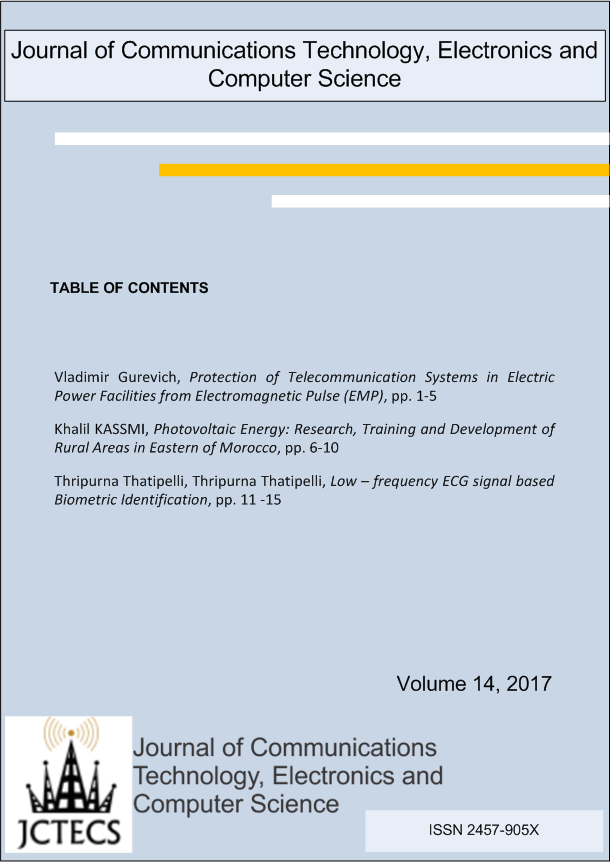
Photovoltaic Energy: Research, Training and Development of Rural Areas in Eastern of Morocco
DOI:
https://doi.org/10.22385/jctecs.v14i0.220Keywords:
Photovoltaic energy, lighting homes, water pumping, Boost converter, MPPT controller, Batteries,Abstract
The work presented in this paper comes within the framework of a university partnership and socio-economic sectors HAE Association and National Initiative for Human Development (NIHD) established by the Moroccan government for the development of rural communities whose their resources are limited. The main objective is on the one hand, the promotion of renewable energy photovoltaic, and on the other hand, the opening of the university on the socio-economic environment, which aims to improve the population life conditions of isolated zones through the installation of photovoltaic plants (PV). In fact, in this article we contribute in improving the functioning of PV installations. This is by the insurance of better adaptation of the PV generator to the load (batteries ...) regardless sudden changes of weather conditions and with a proposed MPPT control, in order to decrease losses and reduce operating costs
Downloads
References
http://www.photovoltaique.info/Couts-d-investissement.html
BAGHAZ Elhadi, Thèse de Doctorat en Sciences (Electronique, Energies Renouvelables (photovoltaïques)) : Architecture discrétisées de gestion de l’énergie fournie par les systèmes photovoltaiques. Université Mohamed Premier, N° 331/15, 2015, Oujda (Morocco),
Juang, P., & Kacira, M. (2013, October). System dynamics of a photovoltaic integrated greenhouse. In International Symposium on New Technologies for Environment Control, Energy-Saving and Crop Production in Greenhouse and Plant 1037 (pp. 107-112).
Atouk, S. (2013). Les énergies renouvelables et les populations rurales pauvres: le cas du Maroc.
http://ecolo.org/documents/documents_in_french/Solar-Temasol-Maroc-03-05.pdf
Schaber, K., Steinke, F., Mühlich, P., & Hamacher, T. (2012). Parametric study of variable renewable energy integration in Europe: Advantages and costs of transmission grid extensions. Energy Policy, 42, 498-508.
Scheer, H. (2013). The solar economy: Renewable energy for a sustainable global future. Routledge.
http://www.indh.gov.ma/index.php/fr/presentation
Khanna, R., Zhang, Q., Stanchina, W. E., Reed, G. F., & Mao, Z. H. (2014). Maximum power point tracking using model reference adaptive control. Power Electronics, IEEE Transactions on, 29(3), 1490-1499.
Abbes, H., Abid, H., Loukil, K., Toumi, A., & Abid, M. (2014). Etude comparative de cinq algorithmes de commande MPPT pour un système photovoltaïque. Revue des Energies Renouvelables, 17(3), 435-445.
K. Hirech, M. Melhaoui, F. Yaden, E. Baghaz, K. Kassmi, ‘Design and realization of an autonomous system equipped with a regulator of charge/discharge and digital MPPT command’, Energy Procedia. 42 (2013) 503-512
Hirech, K., Melhaoui, M., Malek, R., & Kassmi, K. (2016). A PV System Equipped with a Commercial and Designed MPPT Regulators. In Proceedings of the Mediterranean Conference on Information & Communication Technologies 2015 (pp. 493-503). Springer International Publishing.
Downloads
Published
Issue
Section
License
The journal is currently an open access journal.
The articles receive both rigorous peer-review and expedited online publication.
The journal encourages young researchers to submit their unpublished papers.
The authors retain their article’s copyright.
The authors retain publishing rights without restrictions.
Thus, authors may use their own articles for the following non-commercial purposes without asking our permission (and subject only to acknowledging first publication in Journal of Communications Technology, Electronics and Computer Science and giving a full reference or web link, as appropriate).
Authors cannot submit a manuscript for publication to other journals simultaneously. It is a waste of valuable resources because editors and referees spent a great deal of time processing submitted manuscripts. It is also unethical to republish similar research articles (text/figures/tables) again because journals have limited page space and it most likely violates copyrights which have already been transferred to the first journal. Therefore, all journals require a signed author's copyright transfer agreement stating the originality of the research work submitted through a manuscript. As stated above that authors should submit original, new and unpublished research work to the journal. The ethical issues such as plagiarism, fraudulent and duplicate publication, violation of copyrights, authorship and conflict of interest are serious issues concerning ethical integrity when submitting a manuscript to a journal for publication.
The contents of papers are the sole responsibility of the authors, and publication shall not imply the concurrence of the Editors or Publisher.