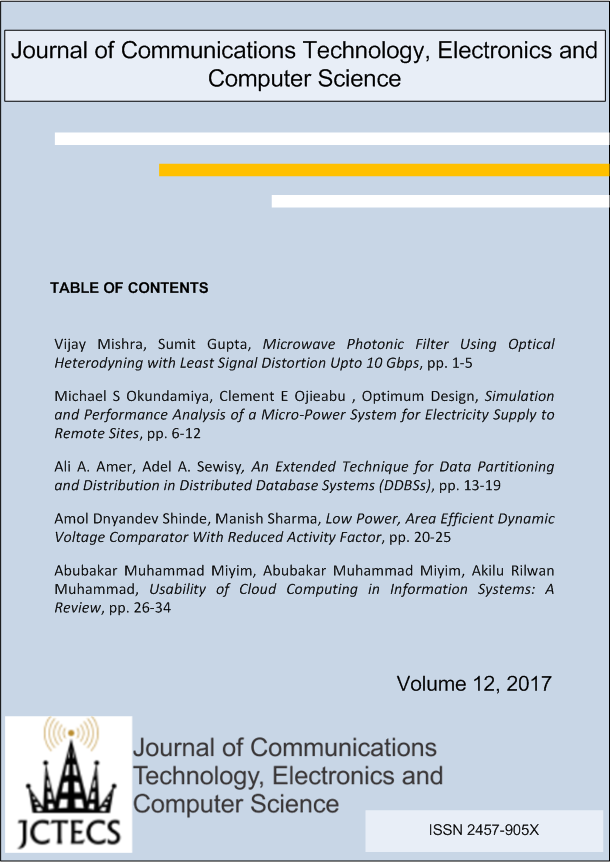
Low Power, Area Efficient Dynamic Voltage Comparator With Reduced Activity Factor
DOI:
https://doi.org/10.22385/jctecs.v12i0.167Abstract
This paper introduces the design of dynamic voltage comparator with reduced activity factor for low voltage and low power operation. An analysis of CMOS circuit power consumption is presented along with implication of activity factor on power consumption. A new architecture based on theoretical analysis for a dynamic comparator is proposed. The proposed comparator has a reduced activity factor and thus it consumes less power and it also has reduced transistor count over the design of double tail dynamic comparator which gives the area efficiency. The proposed design compares small input differential voltages efficiently with low power consumption. All circuit designs are simulated in Tanner tools V16 with 90nm CMOS technology. Simulation result shows that proposed design has less active and standby power consumption.Downloads
References
A. Hajimiri and R. Heald, “Design issues in cross coupled inverter sense amplifier,” IEEE Circuits and Systems, vol. 2, pp. 149-152, 1998.
A. Mesgarani, M. N. Alam, F. Z. Nelson, and S. U. Ay, “Supply boosting technique for designing very low voltage mixed-signal circuits in standard CMOS,” IEEE Int. Midwest Symp. Circuits Syst. Dig. Tech. Papers, pp. 893–896 Aug. 2010.
B. Goll and H. Zimmermann, “A comparator with reduced delay time in 65-nm CMOS for supply voltages down to 0.65,” IEEE Trans. Circuit Syst. II, Exp. Briefs, vol. 56, no. 11, pp. 810–814, Nov. 2009.
B. Goll and H. Zimmermann, “Low-power 600MHz comparator for 0.5V supply voltage in 0.12 μm CMOS,” IEEE Electron. Lett., vol. 43, no. 7, pp. 388–390, Mar. 2007.
B. J. Blalock, “Body-driving as a low-voltage analog design technique for CMOS technology,” IEEE Southwest Symp. Mixed-Signal Design, pp. 113–118, Feb. 2000.
B. Wicht, T. Nirschl, and D. Schmitt-Landsiedel, “Yield and speed optimization of a latch-type voltage sense amplifier,” IEEE J. Solid State Circuits, vol. 39, no. 7, pp. 1148–1158, Jul. 2004.
D. Shinkel, E. Mensink, E. Klumperink, E. van Tuijl, and B. Nauta, “A double-tail latch-type voltage sense amplifier with 18ps Setup+Hold time,” IEEE Int. Solid-State Circuits Conf., Dig. Tech. Papers, pp. 314–315, Feb. 2007.
D. Xu, S. Xu and G. Chen, “High-speed low-power and low-power supply voltage dynamic comparator,” IEEE Electron. Lett., vol. 51, no. 23, pp. 1914-1916, Nov. 2015.
M. Maymandi-Nejad and M. Sachdev, “1-bit quantiser with rail to rail input range for sub-1V Δ modulators,” IEEE Electron. Lett., vol. 39, no. 12, pp. 894–895, Jan. 2003.
N. Bala, B. Abdul and B. Nagendra, “Domino logic based high speed dynamic comparator,” IEEE Int. innovations in information embedded and comm. Systems, 2015.
Neil weste and David Harris, “CMOS VLSI design a circuits and systems perspective”, New York, Addison-Wesley, fourth edition.
S. Gawhare and A. Gaikwad, “Area and power efficient high speed voltage comparator,” Int. automatic control and dynamic optimization techniques, pp. 198-201, 2016.
S. Haung, L. He, Y. Chou and F. Lin, “A 288-uW 6-GHz hybrid dynamic comparator with 54-ps delay in 40-nm CMOS,” IEEE, 2016.
S. Mashhadi and R. Lotfi, “Analysis and design of a low-voltage low power double tail comparator,” IEEE Trans. VLSI Systems, vol. 22, no. 2, Feb. 2014.
S. U. Ay, “A sub-1 volt 10-bit supply boosted SAR ADC design in standard CMOS,” Int. J. Analog Integr. Circuits Signal Process., vol. 66, no. 2, pp. 213–221, Feb. 2011.
Downloads
Published
Issue
Section
License
The journal is currently an open access journal.
The articles receive both rigorous peer-review and expedited online publication.
The journal encourages young researchers to submit their unpublished papers.
The authors retain their article’s copyright.
The authors retain publishing rights without restrictions.
Thus, authors may use their own articles for the following non-commercial purposes without asking our permission (and subject only to acknowledging first publication in Journal of Communications Technology, Electronics and Computer Science and giving a full reference or web link, as appropriate).
Authors cannot submit a manuscript for publication to other journals simultaneously. It is a waste of valuable resources because editors and referees spent a great deal of time processing submitted manuscripts. It is also unethical to republish similar research articles (text/figures/tables) again because journals have limited page space and it most likely violates copyrights which have already been transferred to the first journal. Therefore, all journals require a signed author's copyright transfer agreement stating the originality of the research work submitted through a manuscript. As stated above that authors should submit original, new and unpublished research work to the journal. The ethical issues such as plagiarism, fraudulent and duplicate publication, violation of copyrights, authorship and conflict of interest are serious issues concerning ethical integrity when submitting a manuscript to a journal for publication.
The contents of papers are the sole responsibility of the authors, and publication shall not imply the concurrence of the Editors or Publisher.