Threshold-based hybrid relay selection and power allocation scheme
DOI:
https://doi.org/10.22385/jctecs.v8i0.126Keywords:
communication,Abstract
Abstract—To minimize total transmit power in a system while guaranteeing the outage probability at the same time in a cooperative system, we propose and analyse two threshold-based hybrid relay selection and power allocation schemes for a three-node cooperative relaying system. They are designated as: the hybrid amplify-direct-forward relaying (HADF) and incremental hybrid decode-direct-forward relaying (IHDDF) schemes. In the HADF scheme, a specific outage probability threshold is derived to determine that the system chooses to optimize power allocation of its source and relay in amplify-and-forward (AF) mode or optimize the power of its source in direct-transmit (DT) mode without a relay. In IHDDF, according to the outage probability threshold, the system chooses to optimize its power in turn with incremental decode-and-forward opportunistic relaying (IDFO) mode or DT mode. Closed-form expressions of the total transmit power of the proposed HADF and IHDDF schemes are derived. The proposed schemes have low computational complexity and system cost. Theoretical analysis and simulation results show that the HADF scheme outperforms the AF and DT schemes, and the total transmission power of the IHDDF scheme is reduced significantly compared with the IDFO and DT schemes. Compared with the HADF scheme, the IHDDF scheme has a better total transmit power in special channel condition.
Keywords—power allocation, three-node cooperative relaying system, amplify-and-forward, incremental decode-and-forward opportunistic relaying.
Downloads
References
I. Ku, C. X. Wang and J. Thompson, “Spectral, energy and economic efficiency of relay-aided cellular networks,” IET Commun. vol. 7, pp. 1476–1486, 2013.
ChengXiang Wang, Xuemin Hong, Xiaohu Ge and Xiang Cheng, Cooperative MIMO channel models: A survey, IEEE Commun. Mag. vol. 48, pp. 80–87, 2010.
A. Sendonaris, E. Erkip and B. Aazhang, User cooperation diversity, part I: System description, IEEE Trans. Commun. vol. 51, pp. 1927–1938, 2003.
A. Sendonaris, E. Erkip and B. Aazhang, User cooperation diversity, part II: Implementation aspects and performance analysis, IEEE Trans. Commun. vol. 51, pp. 1938–1948, 2003.
A. Sendonaris, E. Erkip and B. Aazhang, User cooperation diversity-Part I: System description, IEEE Trans. Commun. vol. 51, pp. 1927–1938, 2003.
J. N. Laneman, D. N. C. Tse and G. W. Wornell, Cooperative diversity in wireless networks: Efficient protocols and outage behavior, IEEE Trans. Inform. Theory . vol. 50, pp. 3062–3080, 2004.
Kamel Tourki, Yang Hong-Chuan, Mohamed-Slim Alouini.
Accurate outage analysis of incremental decode-and-forward opportunistic relaying. IEEE Transactions on Wireless Commun. vol. 10, pp. 1021–1025, 2011.
J. N. Laneman and G. W. Wornell, Distributed space-time-coded protocols for exploiting cooperative diversity in wireless networks, IEEE Trans. Inform. Theory. vol. 49, pp. 2415–2425, 2003.
M. Janani, A. Hedayat, T. Hunter and A. Nosratinia, Coded cooperation in wireless communications: Space-time transmission and iterative decoding, IEEE Trans. Signal Processing. vol. 52, pp. 362–371, 2004.
G. Kramer, M. Gastpar and P. Gupta, Cooperative strategies and capacity theorems for relay networks, IEEE Trans. Inform. Theory. vol. 51, pp. 3037–3063, 2005.
A. H. Bastami and A. Olfat, Optimal SNR-based selection relaying scheme in multi-relay cooperative networks with distributed space-time coding, IET Commun. vol. 4, pp. 619–630, 2010.
A. Host-Madsen and J. Zhang, Capacity bounds and power allocation for wireless relay channels, IEEE Trans. Inform. Theory. vol. 51, pp. 2020–2040, 2005.
F. A. Onat, Threshold selection for SNR-based selective digital relaying in cooperative wireless networks, IEEE Trans. Wireless Commun. vol. 7, pp. 4226–4237, 2008.
A. Reznik, S. R. Kulkarni and S. Verdú, Degraded Gaussian multirelay channel: Capacity and optimal power allocation, IEEE Trans. Inform. Theory. vol. 50, pp. 3037–3046, 2004.
M. O. Hasna and M.-S. Alouini, Optimal power allocation for relayed transmissions over Rayleigh-fading channels, IEEE Trans. Wireless Commun. Vol.3, pp. 1999–2004, 2004.
M. Dohler, A. Gkelias and H. Aghvami, Resource allocation for FDMA-based regenerative multihop links, IEEE Trans. Wireless Commun. vol. 3, pp. 1989–1993, 2004.
I. Maric and R. D. Yates, Bandwidth and Power Allocation for Cooperative Strategies in Gaussian Relay Networks, IEEE Transactions on Information Theory. vol. 51, pp. 1880–1889, 2010.
X. Cai, Y. Yao and G. B. Giannakis, Achievable rates in low-power relay links over fading channels, IEEE Trans. Commun. vol. 53, pp. 184–194, 2005.
Y. Li, S. Tong and T. Li, Hybrid Fuzzy Adaptive Output Feedback Control Design for MIMO Time-Varying Delays Uncertain Nonlinear Systems, IEEE Transactions on Fuzzy Systems. vol. PP, pp. 1, 2015.
Y. Li, S. Tong and T. Li, Composite Adaptive Fuzzy Output Feedback Control Design for Uncertain Nonlinear Strict-Feedback Systems With Input Saturation, IEEE Transactions on Cybernetics. vol. 45, pp. 2299–2308, 2015.
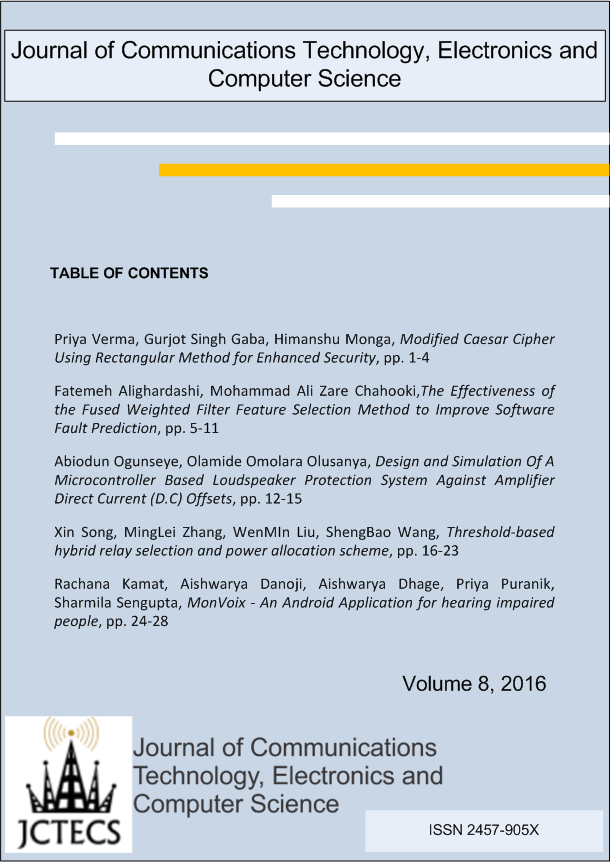
Downloads
Published
Issue
Section
License
The journal is currently an open access journal.
The articles receive both rigorous peer-review and expedited online publication.
The journal encourages young researchers to submit their unpublished papers.
The authors retain their article’s copyright.
The authors retain publishing rights without restrictions.
Thus, authors may use their own articles for the following non-commercial purposes without asking our permission (and subject only to acknowledging first publication in Journal of Communications Technology, Electronics and Computer Science and giving a full reference or web link, as appropriate).
Authors cannot submit a manuscript for publication to other journals simultaneously. It is a waste of valuable resources because editors and referees spent a great deal of time processing submitted manuscripts. It is also unethical to republish similar research articles (text/figures/tables) again because journals have limited page space and it most likely violates copyrights which have already been transferred to the first journal. Therefore, all journals require a signed author's copyright transfer agreement stating the originality of the research work submitted through a manuscript. As stated above that authors should submit original, new and unpublished research work to the journal. The ethical issues such as plagiarism, fraudulent and duplicate publication, violation of copyrights, authorship and conflict of interest are serious issues concerning ethical integrity when submitting a manuscript to a journal for publication.
The contents of papers are the sole responsibility of the authors, and publication shall not imply the concurrence of the Editors or Publisher.