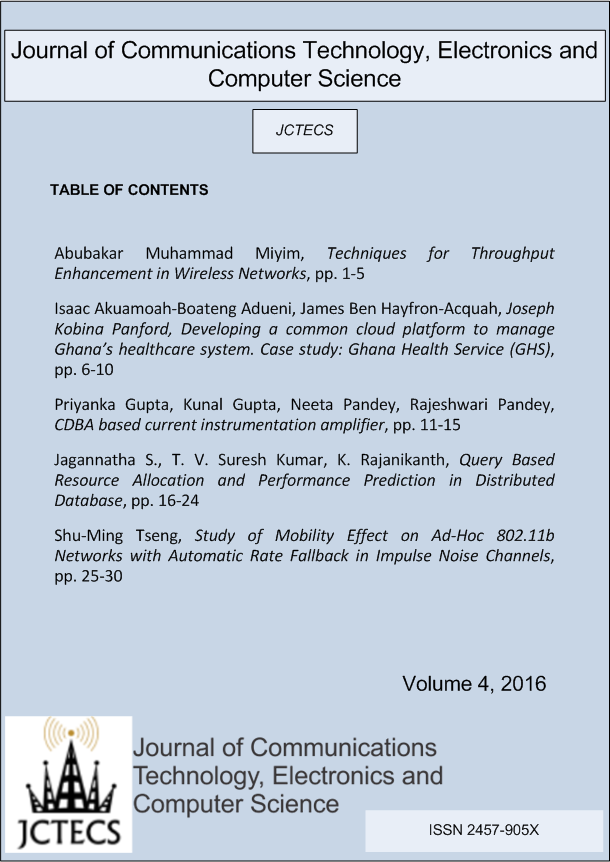
Developing a common cloud platform to manage Ghana’s healthcare system. Case study: Ghana Health Service (GHS)
DOI:
https://doi.org/10.22385/jctecs.v4i0.25Keywords:
Cloud Computing, Healthcare delivery, Infrastructure as a Service, Platform as a Service, Common Cloud InfrastructureAbstract
Cloud computing integration into healthcare services can bring about significant benefits economically, and increase the formation and effective organization of integrated healthcare delivery systems. The second section contains data from different sources, takes a gander at cloud applications in healthcare from the perspective of governmental offices, researchers and computer specialists. This work sorts to create a common cloud platform that can be used to manage Ghana’s healthcare delivery system. The application of innovative information technology driven services in healthcare systems has the potential to enhance operational efficiency, provide collaboration and improve patient outcomes. Available information indicates that healthcare services are in dire need of attention with respect to providing efficient, cost effective and timely delivery of healthcare services. It details different shades of opinion, experience, applicability the development, use and integration of cloud technology into healthcare systems.References
A new era in healthcare: How cloud computing changes the game – Accenture (2013)
Allen, S. (2011). Cloud Computing and Health Care Security. Cloud Computing Journal. Retrieved from
http://cloudcomputing.sys-con.com/node/1796151
Advancing healthcare Delivery with Cloud Computing – COCIR (2012)
Cloud Computing: Building a New Foundation for Healthcare – IBM (2011)
Ghana Health Service Report (2014)
Hospitals In Ghana (2014) http://ghanahospitals.org/home/. Accessed on 23.03.15
Impact of Cloud Computing on Healthcare – Cloud Standards Customer Council (2012). www.cloud-council.org/cscchealthcare110512.pdf. Accessed on 16.04.15
Nabil Sultan (2014), Making use of cloud computing for healthcare provision: Opportunities and challenges. International Journal of Information Management 34(2) 177– 184
Downloads
Published
Issue
Section
License
The journal is currently an open access journal.
The articles receive both rigorous peer-review and expedited online publication.
The journal encourages young researchers to submit their unpublished papers.
The authors retain their article’s copyright.
The authors retain publishing rights without restrictions.
Thus, authors may use their own articles for the following non-commercial purposes without asking our permission (and subject only to acknowledging first publication in Journal of Communications Technology, Electronics and Computer Science and giving a full reference or web link, as appropriate).
Authors cannot submit a manuscript for publication to other journals simultaneously. It is a waste of valuable resources because editors and referees spent a great deal of time processing submitted manuscripts. It is also unethical to republish similar research articles (text/figures/tables) again because journals have limited page space and it most likely violates copyrights which have already been transferred to the first journal. Therefore, all journals require a signed author's copyright transfer agreement stating the originality of the research work submitted through a manuscript. As stated above that authors should submit original, new and unpublished research work to the journal. The ethical issues such as plagiarism, fraudulent and duplicate publication, violation of copyrights, authorship and conflict of interest are serious issues concerning ethical integrity when submitting a manuscript to a journal for publication.
The contents of papers are the sole responsibility of the authors, and publication shall not imply the concurrence of the Editors or Publisher.