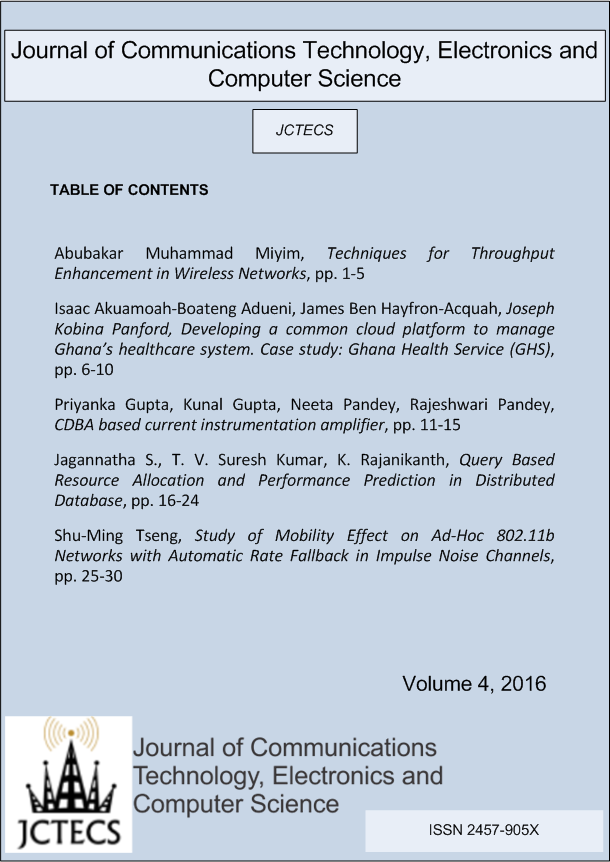
Techniques for Throughput Enhancement in Wireless Networks
DOI:
https://doi.org/10.22385/jctecs.v4i0.11Keywords:
Throughput, Performance, Timeout, TCP, wireless networksAbstract
In wireless systems, unnecessary signal degradation are caused by spurious timeouts from highly variable round-trip times (RTTs) for transmission control protocol (TCP). This paper proposes two methods of improving TCP throughput in wireless networks. Selecting a threshold higher than standard for retransmission timeout (RTO) and use of select-N-repeat (SNR) and trace-N-retransmit (TNR) as retransmission policies upon packet timeout are the two techniques adopted in this study. Simulations reveals that the former method helps reduce timeouts and provides relative throughput gain in a simulated network environment. However in the later method, TNR was found to improve throughput gain by about 8% over the SNR policy when packets at the receiver end arrive out-of-order.References
D. Gupta and A. K. Sharma, “On Performance Evaluation of WSN Routing Protocols for MICA and MICAz using Different Radio Models”, International Journal of Energy, Information and Communications, November 2011, 2(4): 181-194.
X. Wang & Q. Liang, “On the Throughput Capacity and Performance Analysis of Hybrid Wireless Networks over Fading Channels”, IEEE Transactions on Wireless Communications, 2013, 12(6):2930 - 2940.
M. Amnai, Y. Fakhri, J. Abouchabaka, “Impact of Mobility on Delay-Throughput Performance in Multi-Service Mobile Ad-Hoc Networks,” Int’l Journal of Communications, Network and System Sciences, 2011, (4): 395-402.
R. Chakravorty, S. Katti, J. Crowcroft and I. Pratt, “Flow Aggregation for Enhanced TCP over
wide-area wireless”, submitted to IEEE INFOCOM 2003,
source: http://www.cl.cam.ac.uk/users/rc277/gprs.htmlS.
H. Balakrishnan, S. Seshan, E. Amir and R. H. Katz, “Improving TCP/IP Performance over Wireless Networks,” Proc. 1st ACM Int’l Conf. on Mobile Computing and Networking (Mobicom), November 1995, pp. xxx-xxx.
Fu, et. al., “Effect of Delay Spike on SCTP, TCP Reno and Eifel in a Wireless Mobile Environment,” Proc. of International Conf. on Computer Communications and Networks, Oct. 2002, pp. 575-578.
A. Gurtov and R. Ludwig, “Responding to Spurious Timeouts in TCP,” in Proc. of IEEE Infocom, Mar. 2003.
F. Xie, J. L. Hammond and D. L. Noneaker, “Evaluation of a Split-Connection Mobile Transport Protocol,” Wireless Networks, Vol. 9, 2003, pp. 593-603.
Z. Fu, P. Zerfos, H. Luo, S. Lu, L. Zhang, M. Gerla, “The Impact of Multi-hop Wireless Channel on TCP Throughput and Loss,” Proceedings of IEEE INFOCOM 2003, pp. xx-xx
T. E. Klein, et. al., “Avoiding Spurious TCP Timeouts in Wireless Networks by Delay Injection,” submitted for publication, 2004.
L. T. Nguyen, R. Beuran, Y. Shinoda, “Performance Analysis of IEEE 802.11 in Multi-hop Wireless Networks”, Proceedings of Third International Conference, MSN 2007 Beijing, China, December 12-14, pp326-337.
Downloads
Published
Issue
Section
License
The journal is currently an open access journal.
The articles receive both rigorous peer-review and expedited online publication.
The journal encourages young researchers to submit their unpublished papers.
The authors retain their article’s copyright.
The authors retain publishing rights without restrictions.
Thus, authors may use their own articles for the following non-commercial purposes without asking our permission (and subject only to acknowledging first publication in Journal of Communications Technology, Electronics and Computer Science and giving a full reference or web link, as appropriate).
Authors cannot submit a manuscript for publication to other journals simultaneously. It is a waste of valuable resources because editors and referees spent a great deal of time processing submitted manuscripts. It is also unethical to republish similar research articles (text/figures/tables) again because journals have limited page space and it most likely violates copyrights which have already been transferred to the first journal. Therefore, all journals require a signed author's copyright transfer agreement stating the originality of the research work submitted through a manuscript. As stated above that authors should submit original, new and unpublished research work to the journal. The ethical issues such as plagiarism, fraudulent and duplicate publication, violation of copyrights, authorship and conflict of interest are serious issues concerning ethical integrity when submitting a manuscript to a journal for publication.
The contents of papers are the sole responsibility of the authors, and publication shall not imply the concurrence of the Editors or Publisher.